Best Photo Spots for Hilo's Waterfalls: 6 Locations Worth the Shot

Planning a visit through our Hilo waterfalls resource? The best hilo waterfall photo spots split into two groups: the drive-up overlooks anyone can reach in a rental car, and the one shot that only a guided zipline tour can deliver. Rainbow Falls' main overlook is where most visitors shoot first, and the window between 9:00 and 10:00am is when the morning sun lights the rising mist into an actual rainbow over the falls. I've guided hikers out to all six of these spots more mornings than I can count, and each one has its own light, its own hazard, and its own best hour to show up. This guide covers the overlooks at Rainbow Falls, Boiling Pots and ʻAkaka Falls, the private pool access at Kulaniapia Falls, and the aerial line above KoleKole Falls that no footpath on this island reaches.
Quick answer
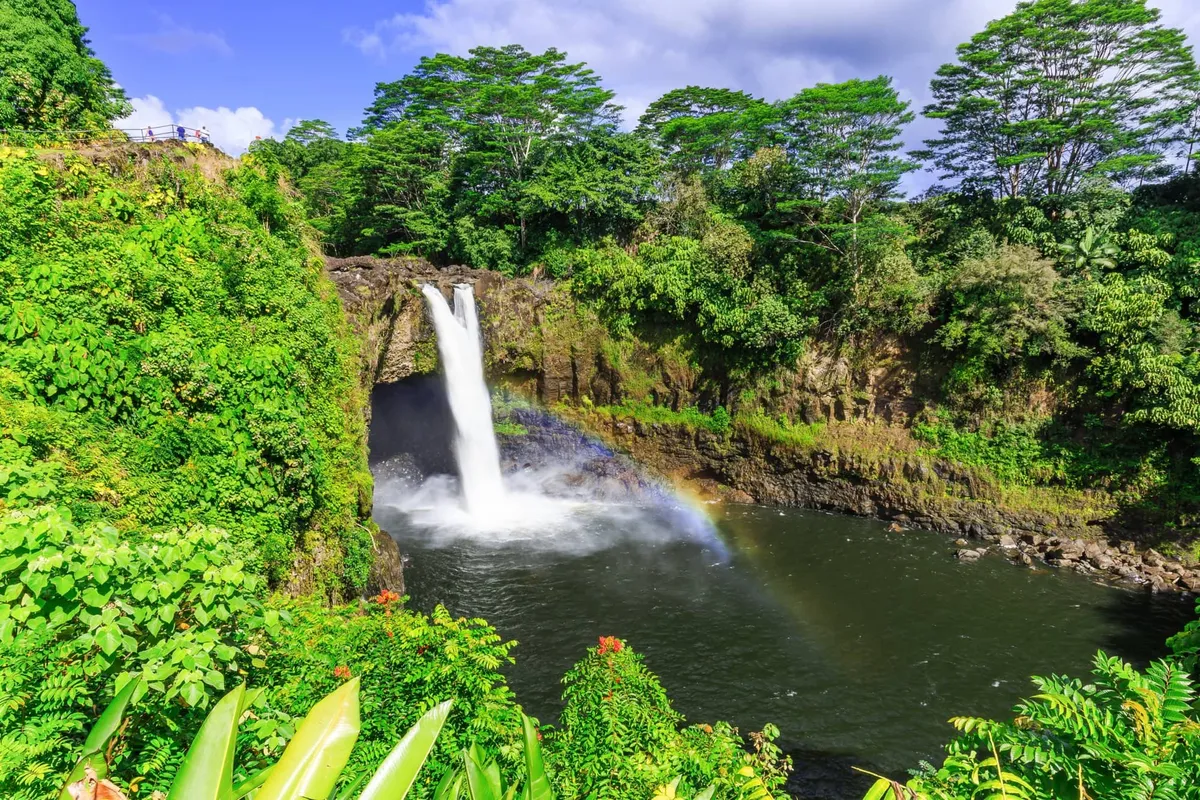
The single best hilo waterfall photo spot for the classic shot is the main Rainbow Falls overlook between 9:00 and 10:00am, when the morning sun lights the rising mist into a rainbow over the falls. For something no walk-up spot can match, the zipline tour that crosses above KoleKole Falls near ʻAkaka is the only vantage that puts you in the air over a 250-foot drop.
Key takeaways
- Rainbow Falls' main overlook, shot between 9:00 and 10:00am, is the top spot for the rainbow and the easiest to reach, 2 miles from downtown Hilo
- A numbered map further down marks all 6 spots with GPS coordinates, drive time and access type
- The KoleKole Falls aerial view is tour-only, reachable solely from the zipline platform above the water near ʻAkaka Falls
- Overcast weather, common on most Hilo days, works in your favor here, removing blown highlights and allowing longer, silkier exposures
- Flying a drone at Wailuku River State Park or ʻAkaka Falls State Park requires a Hawaiʻi DLNR permit; handheld photography is free everywhere on this list
- Kulaniapia Falls is the one spot on this list where a paid day pass gets you to the edge of the pool itself, not just an overlook railing
Photo Spots at a Glance
Here's the short version before the details below: what each spot gives you, when to show up, and what it costs to get there.
| Spot | Best time | The shot you get | How to get there | Fee |
|---|---|---|---|---|
| Rainbow Falls (main overlook) | 9:00 to 10:00am | Full falls plus the mist rainbow | 2 mi / 5 min from downtown Hilo | $5 per person + $10 parking |
| Rainbow Falls (upper viewpoint) | Mid-morning, any overcast hour | Elevated angle through the banyan canopy | Short stair climb from the main lot | Included in the main fee |
| Boiling Pots (Peʻepeʻe Falls) | Mid-morning | Terraced basalt pools on the Wailuku River | 3 mi / 8 min from downtown Hilo | Included in park fee |
| ʻAkaka Falls loop lookout | Overcast midday | The full 442-foot drop into the gorge | 15 mi / 25 min north via Honomū | $5 per person + $10 parking |
| Kulaniapia Falls | Any daylight hour, by reservation | Falls and pool from the water's edge | 4.9 mi / 15 min from downtown Hilo | $49 day pass |
| Wailuku River plunge pool | Overcast, any time of day | Long exposure of the churning river and pool | At the Rainbow Falls area | Included in park fee |
| KoleKole Falls (from the zipline) | Whenever your tour departs | Aerial line above a 250-foot waterfall | Tour pickup north of Hilo | Included in the tour price |
Rainbow Falls does double duty on this list because the main overlook and the upper viewpoint are two different frames of the same waterfall, five minutes apart on foot. The only spot here you can't simply drive to is KoleKole Falls, which makes the list purely because of what the zipline tour lets you see from the air.
Map of the Best Photo Spots
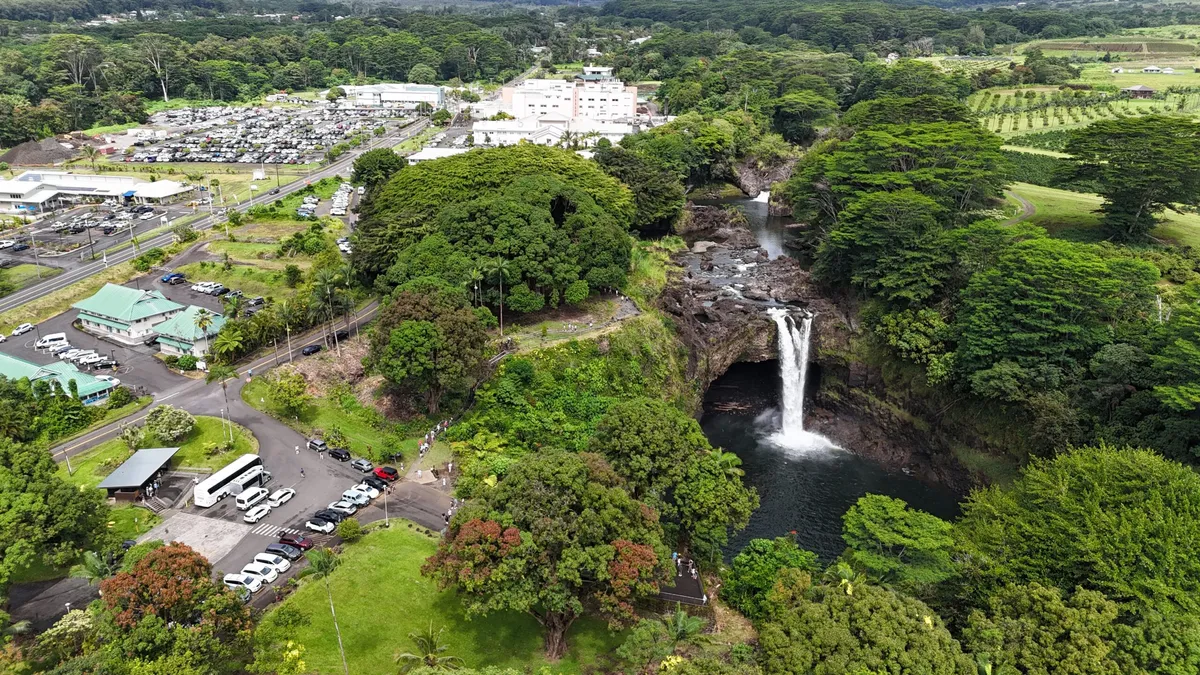
All six numbered spots plus the tour-only KoleKole Falls vantage, with drive times from downtown Hilo.
The 6 Best Photo Spots
1. Rainbow Falls (Main Overlook)
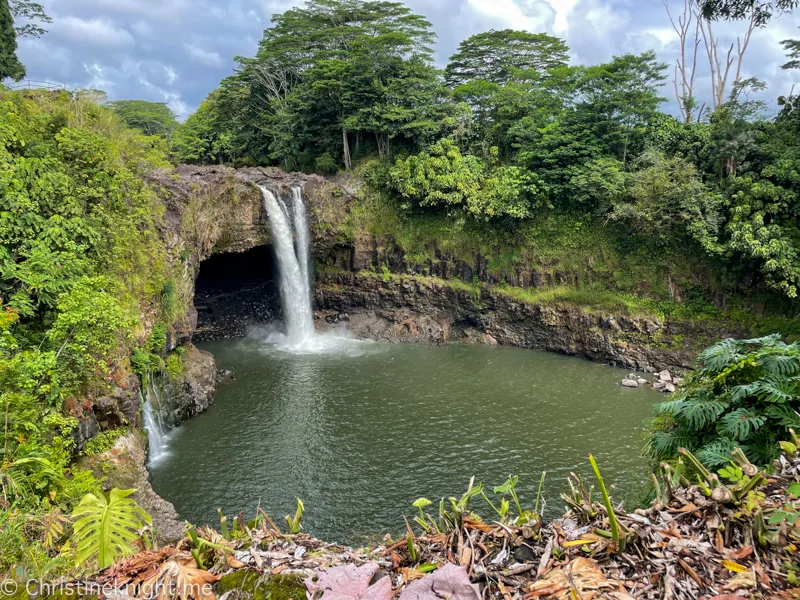
This is the shot most people come to Hilo for: an 80-foot curtain of water falling into a lava cave on the Wailuku River, with a paved overlook set about a hundred feet from the parking lot. Arrive by 9:00 and the light does something the rest of the day can't. As the morning sun angle rises over the falls, it lights the drifting spray below into a rainbow that holds for roughly an hour, thinning out by 10:00 or so as the sun climbs higher and the angle changes.
Shoot wide to get the full drop and the rainbow together, or zoom in on just the base where the color is strongest. The overlook itself is flat and paved, 2 miles and about 5 minutes from downtown Hilo, with a $5 per person entry fee and $10 parking paid by card or QR code at the kiosk. The one hazard worth naming: the railing sits at the edge of a real drop into the gorge, and the rocks near it stay wet and slick from the spray, so keep kids and tripods back from the edge.
Pair this stop with the Big Island half-day volcano and waterfalls tour, which builds a morning Rainbow Falls stop into a half-day that also covers a black sand beach.
2. Rainbow Falls (Upper Viewpoint and Banyan)
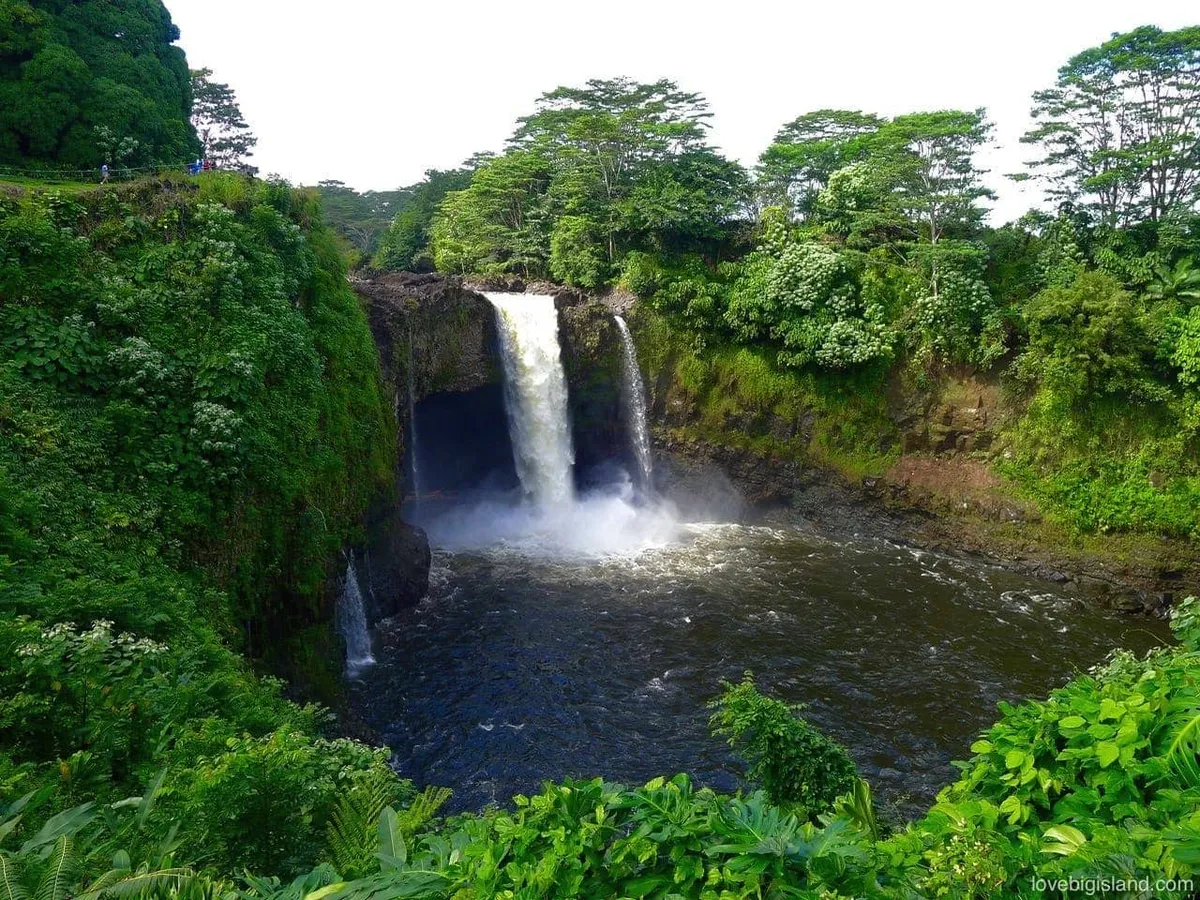
A short flight of stairs above the main overlook puts you on a second, higher vantage that most visitors skip because they don't know it exists. From here you're shooting down and across at the falls instead of straight on, with a massive banyan tree and its curtain of aerial roots framing one side of the picture. It's a slower, quieter stop, the crowd from the main lot rarely climbs up, and the elevated angle works any time the light is flat and overcast, not just in the 9:00 rainbow window below.
Same $5 entry and $10 parking as the main overlook, since it's part of the same small park. The stairs are uneven in spots and the platform at the top is narrow, so this isn't the easiest stop for a wheelchair or a stroller. Give it five extra minutes on your visit, it's an easy add to the main overlook rather than a separate trip.
3. Boiling Pots (Peʻepeʻe Falls Overlook)
A mile up the Wailuku River from Rainbow Falls, the same park fee gets you to a railed overlook above a stretch of terraced basalt pools known as Boiling Pots, named for the way the current churns and bubbles through them after rain. The shot here is less about a single waterfall and more about texture and pattern, dark volcanic rock cut into stair-stepped pools with white water moving through all of them at once. It photographs best in mid-morning, once the sun has cleared the ridge but before midday flattens the shadows in the pools.
This is a look-only stop: swimming here has killed people caught in currents that look calm from the rail but pull hard beneath the surface, so keep the shot to what you can get from the overlook. It's 3 miles and about 8 minutes from downtown Hilo, off Peʻepeʻe Falls Street, and it pairs naturally with a Rainbow Falls stop on the same morning since both sit inside the same small park system.
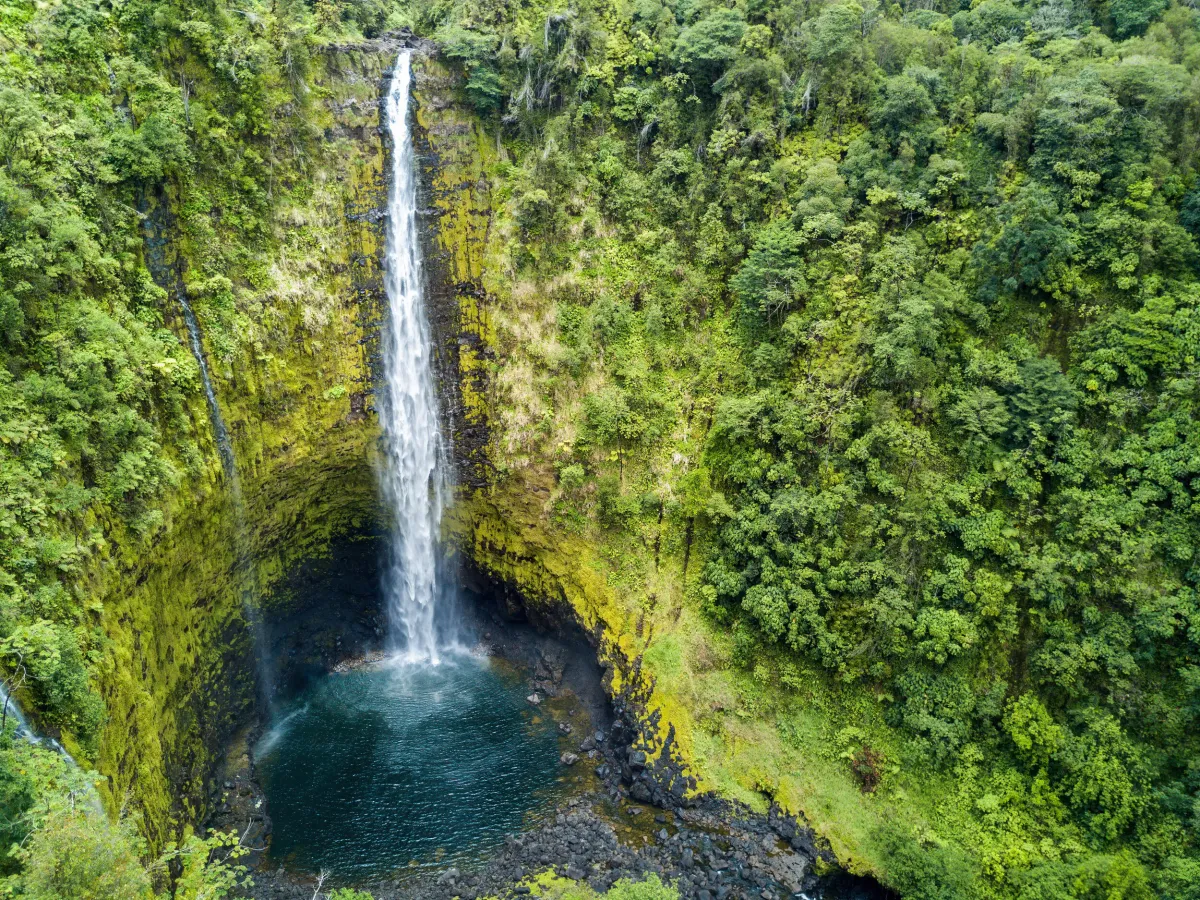
4. ʻAkaka Falls Loop Lookout
ʻAkaka Falls drops 442 feet in a single free fall, visible from a lookout along the park's paved 0.4-mile loop trail, 15 miles and about 25 minutes north of Hilo through Honomū town. This is the one spot on the list where I actually prefer overcast to sun: direct light blows out the white water and buries the gorge in shadow, while a flat gray sky keeps detail in both the falls and the green walls around it. The loop also passes Kahuna Falls on the opposite side, a smaller drop worth a frame while you're there. ʻAkaka Falls State Park opens at 8:30am and closes at 5:00pm, with the same $5 per person and $10 parking structure as Rainbow Falls, paid by card only at the kiosk, no cash.
The trail has some uneven stone steps and a steady incline on the return leg, so it's not a flat stroll, but it's manageable in regular shoes. This same park is the backdrop for the zipline tour above KoleKole Falls, which starts nearby and gets you the one angle this loop trail can't.
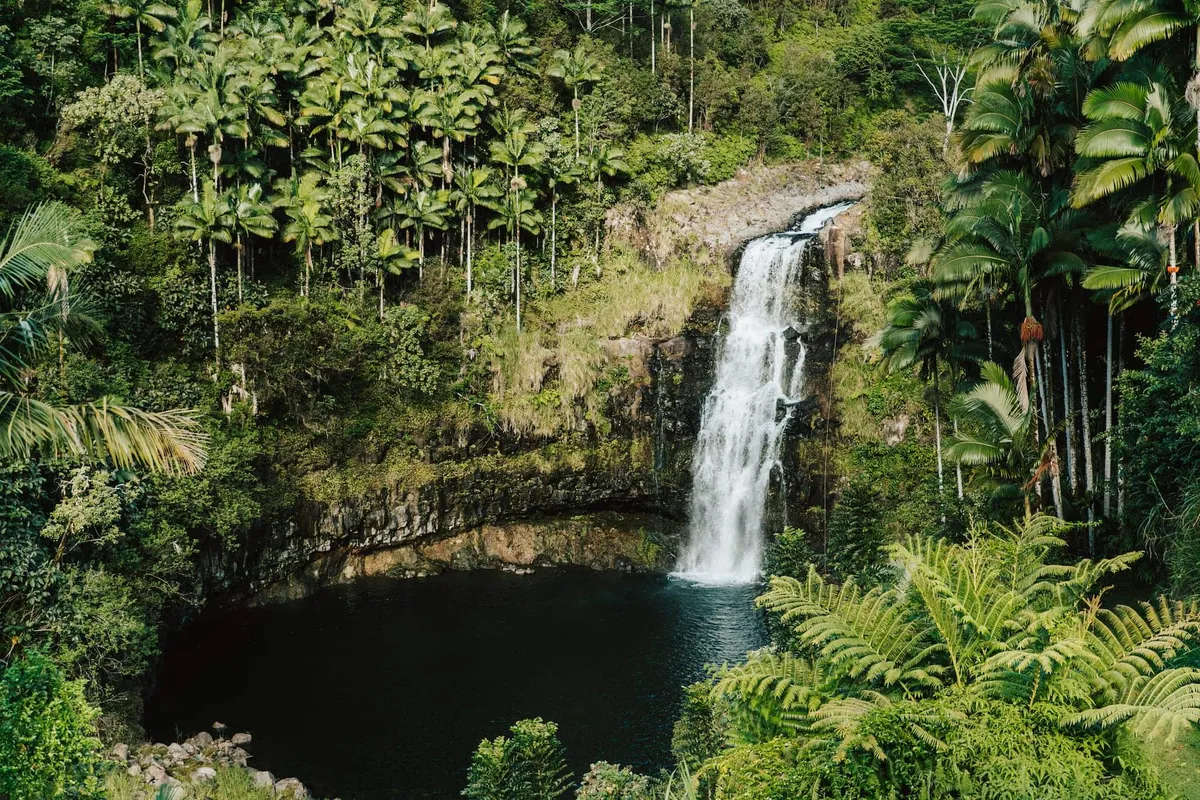
5. Kulaniapia Falls
Kulaniapia is private land, part of an inn a few miles outside downtown Hilo, and it's the one spot on this list where a day pass gets you down to the actual edge of the pool rather than a railed overlook thirty feet back. The 120-foot falls drops into a dark, tree-ringed pool, and shooting from the water's edge gives you a completely different composition than anything at Rainbow Falls or ʻAkaka: low angle, full height of the falls, no crowd in frame most hours. The day pass runs $49, needs to be booked ahead since only about ten guests are let in per day, and it's 4.9 miles and about 15 minutes from downtown Hilo.
Because access is limited and reserved, you'll often have the whole view to yourself, a real contrast to the main Rainbow Falls overlook at mid-morning. Bring water shoes if you plan to get close to the pool edge, the rocks there are uneven and often wet.
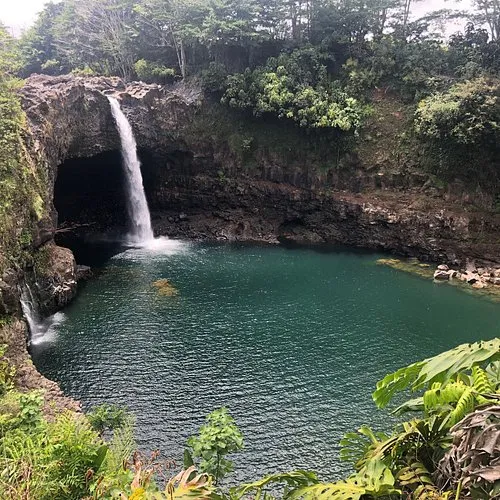
6. Wailuku River Plunge Pool
This last one isn't a separate location so much as a different lens on the same spot: instead of shooting the falls itself, turn your camera downstream at the wide, green plunge pool below Rainbow Falls and the stretch of the Wailuku River feeding out of it. It's a good frame for a long exposure, since the water here moves slower than at the falls' base and smooths out nicely at a half-second or longer. Overcast days work best again, since a bright sky blows out the water's surface and fights with the reflected green of the pool.
There's no separate fee or drive, since it's shot from the same Rainbow Falls overlook and park area covered in the first two spots on this list, just a different direction to point the camera before you leave.
The Shot Only the Tour Gets: KoleKole Falls From the Zipline
Every spot above is something you can drive to and shoot on your own schedule. This one isn't. The zipline tour that runs near ʻAkaka Falls crosses a quarter-mile line directly above KoleKole Falls, a roughly 250-foot drop on the same river system, and the aerial angle you get from the middle of that crossing doesn't exist from any trail, road or overlook on this island.
You're looking straight down the length of the falls from open air, harnessed to a cable, with the pool and gorge below instead of framed from the side. It's the one photo on this list I can't tell you how to get for free, because there isn't a free way to get it. Bracing for the shot matters more than any camera setting: keep both hands and your camera strap secure before you try to shoot, since the platform is moving and the wind picks up mid-crossing.
A fast shutter, at least 1/500, freezes both your own motion and the spray coming off the falls below, and a wrist strap or chest harness for your phone or camera is worth using rather than trusting your grip alone. Guides on the zipline tour above KoleKole Falls run seven lines total and know exactly where the crossing slows down enough for a clean shot, so ask before you launch which line gives you the longest look at the falls. It runs about 2.5 hours from Hilo pickup to drop-off, all gear included, and it's the only entry on this list built around a single unrepeatable shot rather than a nice-to-have add-on.
Book it specifically for the photo if that's your goal, not as an afterthought to a day built around the walk-up spots.
Camera and Phone Settings That Work Here
Hilo is overcast more mornings than not, and that's a gift for waterfall photography rather than a problem: flat light means no blown-out white water and no deep black shadows fighting for the same frame, so you can push a slower shutter, a half-second or longer, and get that silky-water look without carrying a tripod. Bracing your elbows on the overlook rail does almost the job of a tripod at these distances. The one shot that needs direct sun rather than clouds is the Rainbow Falls mist rainbow, which only shows up in that 9:00 to 10:00am window when the sun angle is right, so don't expect it on a fully socked-in morning.
| Scenario | What to try | Why it works here |
|---|---|---|
| Overcast falls, any spot | Half-second-plus exposure, brace on the rail | Flat light avoids blown highlights, no tripod needed at this distance |
| Rainbow Falls, 9:00 to 10:00am | Faster shutter, expose for the mist | Direct sun through the spray is what makes the rainbow, not editing |
| From the zipline over KoleKole | 1/500 or faster, wrist strap secured | The platform moves and the wind picks up mid-crossing |
| Phone, any spot | HDR on, skip digital zoom, walk closer instead | Digital zoom loses detail fast; walking in keeps the shot sharp |
Bring a microfiber cloth for the lens or your phone screen, since spray from Rainbow Falls and ʻAkaka drifts further than it looks, and a wet lens ruins a shot faster than bad light does. One honest note on editing: the falls really do look close to what you see in most photos on an overcast day, that green and gray is close to the true color here, but the rainbow shot is real light on a real schedule, not a filter, and it simply won't appear outside that morning window no matter how good your camera is.
Rules, Drones and Permits
If you're bringing a drone, know before you fly: Hawaiʻi's Division of State Parks requires a permit to operate a drone inside Wailuku River State Park, which covers both Rainbow Falls and Boiling Pots, and inside ʻAkaka Falls State Park. Flying without one risks a fine and confiscation, and rangers at both parks do enforce it. Handheld photography, phone or camera, is free at every stop on this list with no permit needed for personal use.
If you're shooting for a commercial project, a brand shoot, a wedding, or anything you're getting paid for, that requires a separate state parks commercial photography permit regardless of whether a drone is involved. Kulaniapia Falls is private land, so its drone and photography rules are set by the property rather than the state, ask when you book the day pass. For the current permit process and fees, the Hawaiʻi DLNR Division of State Parks is the authority to check before your trip, not a tour operator or a blog post.
Which Tours Reach These Spots
Rainbow Falls shows up on nearly every waterfall tour running out of Hilo, since it sits five minutes from downtown and needs no hiking to reach. The Hilo volcano, waterfalls and beach tour and the Big Island half-day volcano and waterfalls tour both build a Rainbow Falls stop into a longer day that also covers a black sand beach. Boiling Pots and the upper viewpoint aren't standard tour stops, they're closer to a self-guided add-on once you're already at the park, and if that's more your style, seeing the falls on your own covers exactly how to plan that kind of day. ʻAkaka Falls appears on some full-day itineraries, but the only way to get the aerial KoleKole shot is the zipline tour that crosses above it, which is built entirely around that one location.
Kulaniapia Falls isn't part of any tour on this list, it's a standalone day pass booked directly with the property. Whatever time of year you're shooting, the best months and morning light breaks down how season and weather change what you'll see through the lens. If you'd rather have someone else handle the driving and the park fees while you focus on the camera, browse the full lineup of Hilo waterfall and rainforest tours and pick the day that matches the spots you most want to shoot.
Frequently Asked Questions
Where is the best place to photograph Hilo's waterfalls?
The main Rainbow Falls overlook, 2 miles from downtown Hilo, gives you the most reliable shot: the full 80-foot falls, an easy paved approach, and a real chance at a mist rainbow if you arrive between 9:00 and 10:00am.
What time does the rainbow appear at Rainbow Falls?
Usually between 9:00 and 10:00am, when the sun angle lights the rising mist below the falls. It fades as the sun climbs higher, and it doesn't appear at all on a fully overcast morning with no direct sun.
Can you fly a drone at Hilo's waterfalls?
Not without a permit. Wailuku River State Park, which covers Rainbow Falls and Boiling Pots, and ʻAkaka Falls State Park both require a Hawaiʻi DLNR drone permit, and rangers do enforce it.
Is overcast weather bad for waterfall photos?
No, it's usually better. Flat, cloudy light avoids blown-out white water and harsh shadows, and it lets you shoot a longer exposure for smoother-looking water without carrying a tripod.
Can you get these photos without a tour?
Five of the six spots, yes. Rainbow Falls, its upper viewpoint, Boiling Pots, ʻAkaka Falls and Kulaniapia Falls, with a day pass, are all self-accessible by car. The aerial shot above KoleKole Falls is tour-only, reachable solely from the zipline.
Do any tours build in time for photos?
Yes. Tours with a morning Rainbow Falls stop, like the half-day volcano and waterfalls tour, are timed to catch the same morning light independent photographers chase, and the zipline tour is paced to let you brace for a shot mid-crossing rather than rush past KoleKole Falls.
I've stood at that Rainbow Falls rail more mornings than I can count, camera up, waiting on a rainbow that either shows or doesn't depending on ten minutes of sun angle I can't control. That's the honest version of waterfall photography here: some of it you can plan around with a clock and a map, and one shot you simply have to go up and get.