What Waterfalls Will You See in Hilo? A Local's Rundown

Planning a visit through our Hilo Hawaii waterfalls resource? Wondering what waterfalls to see in Hilo? You will reliably see two of the island's best, ʻAkaka Falls at 442 feet and Rainbow Falls near downtown, both flowing on almost any day. Others depend on rain: the Boiling Pots and Peʻepeʻe Falls roar after a wet night and flatten in a dry spell, and the morning rainbow at Rainbow Falls is a sunny-day bonus rather than a given. This is a local's honest rundown of the eight falls worth knowing, how tall each one is, how dependable the flow is, and which ones you can actually swim in.
Quick answer
You will almost always see ʻAkaka Falls and Rainbow Falls flowing, you will usually catch Boiling Pots and Peʻepeʻe Falls churning after rain, and on a sunny morning you may see a rainbow in the mist at Rainbow Falls. Nothing here is guaranteed, because every fall depends on how much rain has fallen on Mauna Kea's slopes, but ʻAkaka rarely disappoints.
Key takeaways
- ʻAkaka Falls is the tallest at 442 feet and the most reliable of them all
- Rainbow Falls is the icon, 80 feet over a lava cave, two miles from downtown
- The falls are individual named stops minutes apart, not a Road-to-Hana style drive
- You cannot swim at Rainbow Falls or the Boiling Pots, the legal swims are the guided hike and Kulaniapia
- More rain means fuller falls, so the morning after a wet night is the best time to go
- Kahuna Falls, seen from the ʻAkaka loop, is often a thin flow and easy to miss
Hilo's Waterfalls at a Glance
Here are the eight falls worth knowing, with heights and an honest read on how dependable each one's flow is. Reliability comes down to the size of the watershed feeding it and how recently it has rained.
| Waterfall | Where | Height | How reliable the flow is |
|---|---|---|---|
| ʻAkaka Falls | ʻAkaka Falls State Park, 15 miles north | 442 feet | Full year-round |
| Rainbow Falls | Wailuku River, 2 miles from downtown | 80 feet | Strong most days, thin in drought |
| Peʻepeʻe Falls | Wailuku River, above Boiling Pots | 50 to 60 feet | Best after rain |
| Boiling Pots | Wailuku River terraced pools | Rapids, not a drop | Best after rain |
| Waiʻale Falls | Upper Wailuku River, guided access | Tiered | Best after rain |
| Kahuna Falls | ʻAkaka loop, across the gorge | About 100 feet | Thin in drought |
| Kulaniapia Falls | Private, off Waiau Stream | 120 feet | Strong most days |
| KoleKole Falls | Hāmākua Coast, zipline access | 250 feet | Strong most days |
If you only remember one line from this table: ʻAkaka is the safe bet in any weather, Rainbow Falls is the icon that varies with rain, and the Wailuku River falls near town are at their loud, churning best the morning after a downpour.
Flowing Year-Round: The Reliable Falls
ʻAkaka Falls (442 feet)
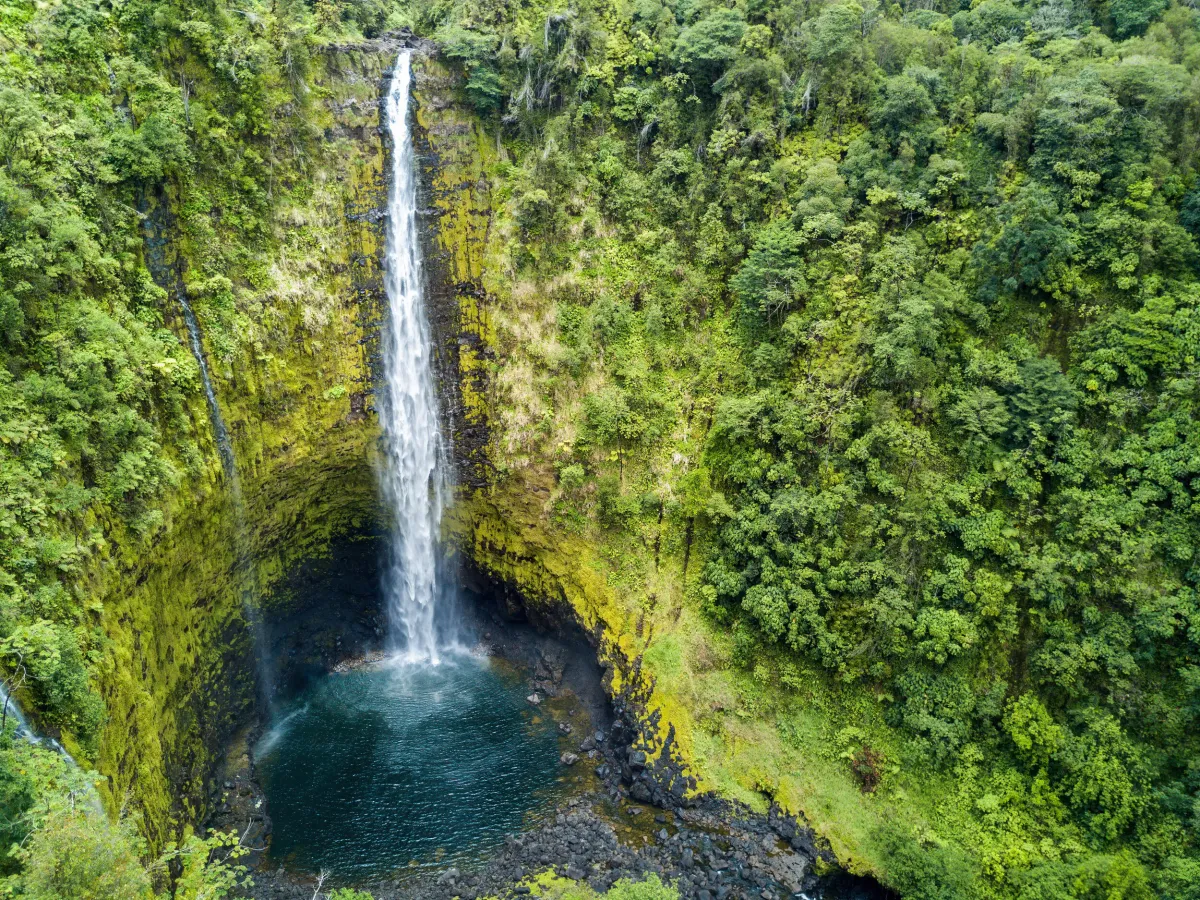
The tallest and most dependable fall on this list, a single free-fall plunging 442 feet into a stream-cut gorge. You reach it on a 0.4-mile paved loop in ʻAkaka Falls State Park, about 15 miles north of Hilo through Honomū. Its watershed is large enough that it runs hard even in a dry stretch, which is why it almost never disappoints.
The full picture of visiting on your own covers the fee and the loop.
Rainbow Falls (Waiānuenue, 80 feet)
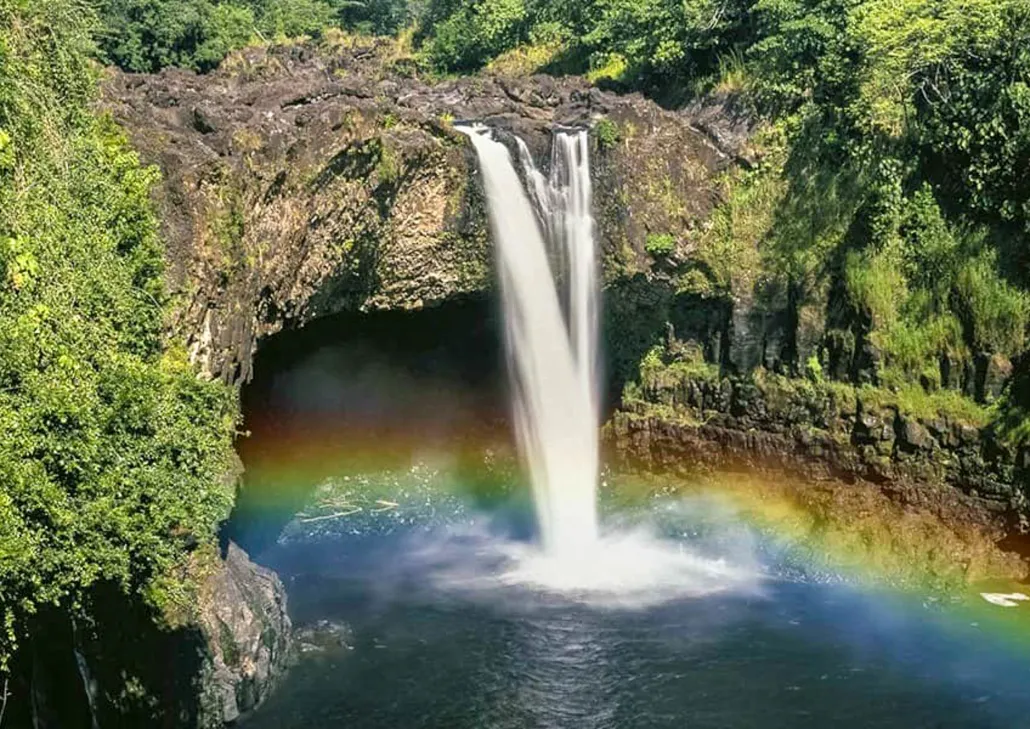
Hilo's icon, an 80-foot fall pouring over a lava cave that Hawaiian tradition says is home to Hina, the moon goddess. Its name, Waiānuenue, means rainbow seen in water, and on a sunny morning around 9 to 10 the sun lights a rainbow in the mist. It is a drive-up lookout two miles from downtown.
Flow is strong most days but noticeably thinner after a dry spell. The best photo spots guide covers the rainbow timing in detail.
Best After Rain: The Wailuku River Falls
Peʻepeʻe Falls (50 to 60 feet)
A wide 50 to 60 foot fall upstream on the Wailuku River, feeding the Boiling Pots just below it. After rain it is powerful and full; in drought it shrinks to a modest flow. You view it from the same railed overlook as the Boiling Pots.
Boiling Pots
Not a single drop but a stair-step of basalt pools where the Wailuku River churns and swirls, appearing to boil after heavy rain. On a dry week the pools can look almost flat. The full-day tour with lunch and other Hilo tours fold in the Wailuku River lookouts.
Swimming is prohibited here, and for good reason, which our safety guide explains.
Waiʻale Falls
A tiered fall higher up the Wailuku River, reached on private alawai trails with a native Hawaiian guide. It roars after rain and is one of only two places you can legally swim near Hilo. The guided waterfall hike and swim is the way in.
The Special Cases
Kulaniapia Falls (120 feet)
A private 120-foot fall off the Waiau Stream, about 15 minutes up from town at an inn that sells day passes. It is the other legal swim near Hilo, with a deep pool at its base. Flow is strong most days thanks to a steady upland stream.
KoleKole Falls (250 feet)
A 250-foot fall on the Hāmākua Coast that you see from the air, crossing above it on a quarter-mile zipline. It is a tour-only view rather than a walk-up lookout. The zipline over KoleKole Falls is the only way to get this angle.
Umauma Falls and Kahuna Falls
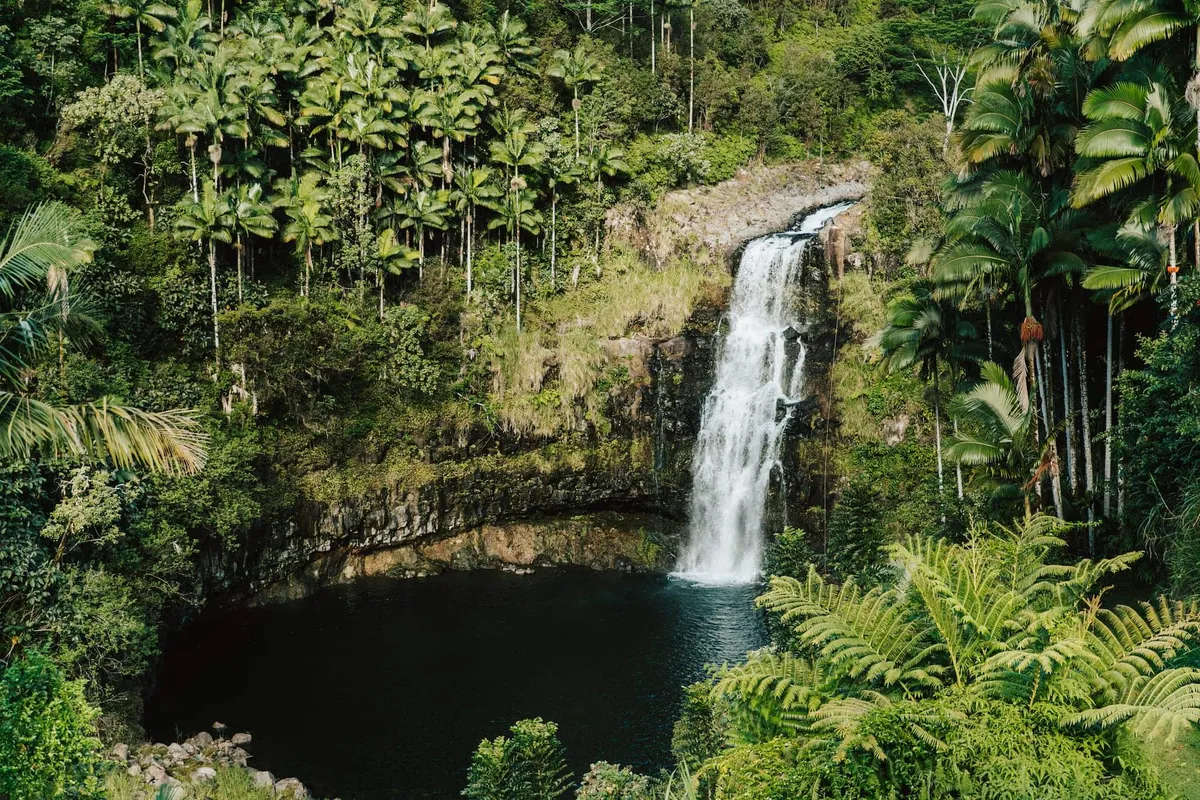
Umauma is a triple-tier fall dropping about 300 feet on the Hāmākua Coast, on private land reached through the zipline and day-pass property. Kahuna Falls, roughly 100 feet, sits across the gorge from ʻAkaka and is visible from the same loop, but it is often a thin, easy-to-miss trickle, so treat it as a bonus rather than a highlight.
Where Each One Sits and How to See It
Grouping the falls by how you reach them makes planning simpler. Rainbow Falls and the Boiling Pots are free drive-up lookouts minutes from downtown, and most guided day tours stop at Rainbow Falls. ʻAkaka is a paved loop 15 miles north with its own park fee. Waiʻale and Kulaniapia are the swimmable pair, one guided, one a private day pass.
KoleKole and Umauma are Hāmākua Coast falls reached through the zipline property.
If you would rather have the driving handled, the half-day volcano and waterfall tour pairs Rainbow Falls with the volcano, and you can compare all the guided tours to Hilo's waterfalls to match one to the falls you most want to see.
When They're at Their Best
The single biggest factor is rain. Because every fall is fed from the Mauna Kea watershed, the falls are fullest the morning after a wet night, and Hilo gives you plenty of those. The rainbow at Rainbow Falls needs morning sun as well as water, so a clear early hour after overnight rain is the ideal.
For the full month-by-month picture, see our guide to the best time to visit Hilo waterfalls.
What You Won't See
A couple of honest expectation-setters. Hilo is not a Road-to-Hana style drive lined with roadside falls; these are individual named waterfalls a few minutes apart, each with its own lookout or trail. You cannot swim at the famous ones, Rainbow Falls and the Boiling Pots, where swimming is prohibited and genuinely dangerous, so the swims are the guided hike to Waiʻale and the Kulaniapia day pass.
And Kahuna Falls, despite sharing the ʻAkaka loop, is frequently a thin trickle, so do not build your visit around it.
Will the Falls Look as Big as the Photos?
Photos can mislead in both directions here. ʻAkaka genuinely reads as tall in person, since you look across a deep gorge at a single unbroken 442-foot ribbon, and most visitors find it more impressive than they expected. Rainbow Falls is wider than it is tall, so it looks broad and powerful after rain but can seem modest in a dry week, which is the opposite of the always-full look on postcards. The Boiling Pots almost never match their dramatic name unless heavy rain has the river churning, so time that stop for after a wet spell.
Overcast light, which Hilo has most days, is actually kind to waterfalls: it softens the water and holds detail that harsh midday sun blows out. The one thing you cannot force is the rainbow at Rainbow Falls, which needs both mist and low morning sun at the same time. Treat it as a lucky bonus rather than the reason you drove out.
Seeing the Falls Responsibly
The state parks that hold these falls are managed by Hawaiʻi's Division of State Parks, and a few simple habits keep them safe and intact. Stay behind the railings at every lookout and never enter the river, especially at Rainbow Falls and the Boiling Pots. Leave plants and rocks where they are, and pack out whatever you bring in.
The wet basalt is slick, so watch your footing near the edges.
How to See the Most
A few things I have learned watching these falls for years. Go the morning after a wet night, when every fall is at full power and the Boiling Pots actually boil. Reach Rainbow Falls between 9 and 10 in the morning for the best odds of a rainbow, and to beat the cruise coaches.
And loop the downtown falls together, Rainbow Falls then the Boiling Pots, since they sit minutes apart on the same river, before driving north to ʻAkaka.
Easiest falls with young kids
Rainbow Falls is the simplest with children, a short paved walk from the car to a railed lookout with the rainbow as a bonus to point out. ʻAkaka's 0.4-mile loop is stroller-awkward but manageable in a carrier, and the 442-foot drop tends to hold a child's attention. For the full family plan, see our guide to Hilo's waterfalls with kids.
Frequently Asked Questions
What is the tallest waterfall in Hilo?
ʻAkaka Falls at 442 feet is the tallest, a single free-fall into a gorge about 15 miles north of Hilo. It is also the most reliable, running hard even in dry weather thanks to its large watershed.
Which Hilo waterfall is the most reliable to see flowing?
ʻAkaka Falls. Its watershed is large enough that it flows strongly year round. Rainbow Falls is dependable most days but thins after a dry spell, and the Wailuku River falls are at their best after rain.
Can you see a rainbow every day at Rainbow Falls?
No. The rainbow only appears when morning sun hits the mist, roughly 9 to 10 in the morning on a clear day. On overcast mornings, which are common in Hilo, the fall is still worth seeing but the rainbow may not form.
How many waterfalls can you see in a day in Hilo?
Comfortably three or four. Rainbow Falls and the Boiling Pots sit minutes apart near downtown, and ʻAkaka Falls is a short drive north. Add a guided hike or the Kulaniapia day pass if you also want to swim.
Which Hilo waterfalls can you swim in?
Only two we recommend: Waiʻale Falls on a guided hike over private trails, and Kulaniapia Falls on a day pass. Swimming is prohibited at Rainbow Falls and the Boiling Pots, where hidden currents and flash floods have proven deadly.
See the reliable pair first, ʻAkaka for the sheer 442-foot drop and Rainbow Falls for the icon and its rainbow, then let the weather decide the rest. Go the morning after rain and the Wailuku River falls will be roaring; either way, the falls are minutes apart and easy to loop in a single Hilo morning.